

Total Solar Eclipse 2027: Spain, Morocco or Egypt?
On August 2, 2027, a total solar eclipse will cross parts of southern Spain, northern Morocco and Egypt. For a few minutes inside the path of totality, the Moon will completely cover the Sun’s bright face. But choosing a country is only the beginning: your exact viewing location determines whether you see totality, how long it lasts and whether buildings or terrain block your view.
This guide compares three starting points—Cádiz, Tangier and Luxor—and explains how to choose a viewing spot, prepare for the weather and enjoy the eclipse with or without a camera.
When Is the 2027 Total Solar Eclipse?
The date is August 2, 2027. The total eclipse reaches the Strait of Gibraltar region in the morning before continuing east across North Africa. NASA’s calculations give a maximum totality duration of approximately 6 minutes 23 seconds along the central path in Egypt. That is the event’s maximum, not the duration everywhere. See NASA’s eclipse path and timing tables.
The partial phases last much longer than totality. Plan to arrive before the eclipse begins locally, rather than treating the time of maximum eclipse as your arrival time. You will want time to find your spot, prepare your solar viewers and check your equipment.
Where Can You See Totality?
Totality is visible only within a narrow corridor called the path of totality. Outside it, observers see a partial eclipse. Even a location with nearly all of the Sun covered does not get the same experience as a location where the bright face disappears completely.
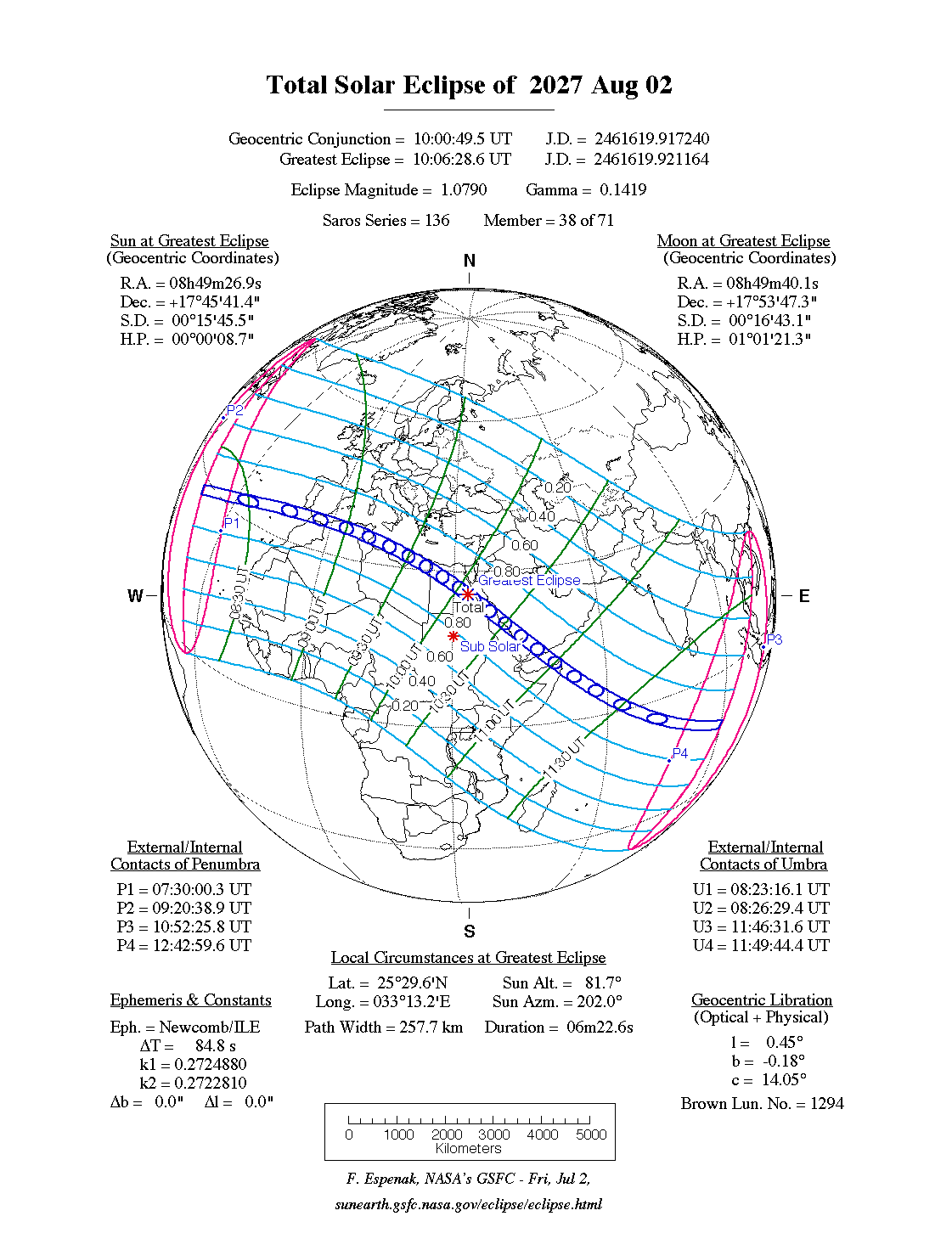
Map credit: Fred Espenak, NASA/GSFC. This overview is useful for understanding the route; use the interactive NASA path map to check your exact coordinates before choosing accommodation or a viewing site.
The three countries in this guide cover only part of the route. Do not assume that every destination in Spain, Morocco or Egypt is inside the corridor. A hotel advertised for an eclipse trip may also be outside the path, with transport to a separate observing site.
Spain, Morocco or Egypt: How Do They Compare?
Start with a specific place rather than a country-wide promise. The examples below illustrate how much totality can vary. Times are rounded to the nearest minute and refer to maximum eclipse, not the beginning of totality.
| Example location | Maximum eclipse (UTC) | Approximate totality | Planning priority |
|---|---|---|---|
| Cádiz, Spain | 08:46 | About 3 minutes | Compare nearby sites: duration changes substantially across the region. |
| Tangier, Morocco | 08:47 | About 4 minutes 50 seconds | Check morning coastal cloud and the view from your exact site. |
| Luxor, Egypt | 10:05 | About 6 minutes 20 seconds | Plan for heat, shade and an unobstructed view high in the sky. |
Sources: Spain’s Instituto Geográfico Nacional and the location calculations for Cádiz, Tangier and Luxor. Durations depend on the selected coordinates and calculation model; use these rounded figures to compare destinations, not to time filter removal.
Check your clock: UTC is a shared reference, not necessarily local time. Under current summer-time arrangements, 08:46 UTC is 10:46 in mainland Spain and 10:05 UTC is 13:05 in Egypt. Confirm the local time-zone offset for your destination before travelling, especially when comparing Moroccan schedules. Save the exact local contact times for your observing coordinates.
Southern Spain
Spain’s national observatory identifies Cádiz and Málaga among the cities that will see totality, alongside Ceuta and Melilla. However, the duration is not uniform: its published examples give roughly three minutes for Cádiz and under two minutes for Málaga. Check the official municipality information before choosing a base.
For a Spain-based trip, compare the journey to your viewing spot as carefully as the accommodation. A longer drive to gain extra seconds may be less useful than a reliable site with easy access and room to set up. On a scouting visit, check the morning sky rather than relying on a sunset-facing beach or terrace.
Northern Morocco
Tangier offers close to five minutes of totality in the location calculations linked above. That makes it a useful starting point for comparing northern Moroccan viewing sites, but a city name alone cannot tell you whether a particular rooftop, courtyard or hillside has a clear view.
Keep a practical alternative within reach. Before committing to a terrace or organised event, ask where observers will stand, whether nearby buildings obstruct the Sun and what access is available before the partial phases begin. A famous viewpoint can still face the wrong direction.
Egypt
Luxor’s calculated totality lasts a little over six minutes, making it a strong candidate if viewing time is your main priority. A longer total phase gives you more breathing room to observe, notice changes around you and take a few photographs without spending every moment on equipment.
Choose the observing site as well as the destination. Confirm access, shelter between observations and the availability of drinking water. If you want a monument in a photograph, check permissions and the actual alignment before booking: proximity to a landmark does not mean the eclipse will appear directly above it.
How to Choose Your Exact Viewing Spot
First confirm that your coordinates are comfortably inside the totality corridor. Then inspect the view in the Sun’s direction at eclipse time. An open horizon is helpful, but a gap at ground level is not enough if a roof, tree canopy or mountain blocks the relevant part of the sky.
Compare the Sun’s altitude—its angle above the horizon—as well as its compass direction. NASA’s path tables show a moderately elevated morning Sun near the Strait of Gibraltar and a much higher Sun along the Egyptian part of the central path. That changes both the viewing position and possible photographic compositions.
Use this site checklist before you settle on a location:
- Access: can you enter before the partial eclipse starts, and do you need permission?
- Sky view: will the Sun remain unobstructed throughout the phases you want to watch?
- Comfort: is there somewhere to rest, with shade that does not block the observing position?
- Space: can your group or tripod stand without blocking paths or other visitors?
- Backup: is an alternative site realistically reachable without a rushed last-minute journey?
What Could the Weather Be Like?
Historical climate helps narrow down destinations; it cannot forecast the sky on August 2, 2027. Eclipsophile’s analysis of satellite cloud observations identifies very favourable cloud conditions along much of the Egyptian track, while also discussing coastal low cloud and fog in parts of Morocco and Spain. It highlights intense summer heat in Egypt and the possibility of dust affecting visibility.
That gives you a reason to compare regions, not a guarantee of a clear view. Avoid interpreting a low historical cloud figure as a personal probability of success: datasets may describe different times of day or geographic areas.
In the days before the eclipse, compare forecasts for your main site and backup. On the morning itself, check current satellite imagery, local observations and official forecasts. Allow enough time for any move; a theoretically clearer location is no help if you arrive after totality.
For more on interpreting cloud layers rather than relying on one percentage, read our guide to predicting a colorful sunset. Eclipse viewing has a different goal—an unobstructed Sun—but the distinction between cloud layers and a headline weather icon remains useful.
How to Watch the Eclipse Safely
Follow NASA’s eclipse-viewing safety guidance:
- Use undamaged solar viewers compliant with ISO 12312-2 during every partial phase. Ordinary sunglasses are unsuitable.
- Direct, unfiltered viewing is safe only during confirmed totality, when the Moon completely covers the Sun’s bright face. Restore protection before any bright sunlight returns. Outside the totality path, keep protection on throughout.
- Never look through binoculars, a telescope or a camera’s optical viewfinder using eclipse glasses as protection. Optical instruments need suitable solar filters secured over their front openings.
- Supervise children and check viewers for damage before use.
Keep the eye-protection plan separate from the photography plan. If you are unsure whether totality has begun or ended, keep your solar viewers on.
How to Photograph the Eclipse

Decide what you want to record before choosing equipment. A close-up of the Sun, a wide scene showing the changing light and a video of your group’s reaction are different projects. Trying to capture all three can leave you watching menus instead of the sky.
For direct images of the partial phases, use a purpose-made solar filter suitable for your camera and lens, fitted securely over the front. A normal photographic ND filter is not a substitute. The American Astronomical Society’s imaging guidance explains the different approaches and equipment considerations.
Practise with the intended equipment and suitable solar protection before the trip. Learn how to focus, change exposure and operate the camera without searching through settings. Use a stable support, charge batteries and leave space on your memory card.
During confirmed totality, photographers can remove the solar filter to record the corona, then must replace it before the bright Sun returns. Use a rehearsed timing procedure based on your exact site. If managing that transition feels uncertain, concentrate on watching safely rather than attempting an unfiltered close-up.
A phone can record the atmosphere, surrounding landscape and people’s reactions. For direct solar imaging, follow suitable filter and device guidance rather than relying on digital zoom. Give yourself some time to look up: your own view does not need to compete with a professional photograph.
Plan Your Viewing Location with PhotoTime
Use PhotoTime to explore the Sun’s position for your chosen place and date. Set the location, select August 2, 2027 and check the Sun’s direction at the relevant time. Compare that with the view from your intended observing point.
Use the official eclipse maps and location-specific contact times linked above to establish whether you are inside totality and when it begins and ends. Sun-position planning complements those eclipse calculations; a sunrise or sunset time cannot tell you the eclipse contacts.
Save the details you need before travelling: the viewing coordinates, local times, route and backup location. When you arrive, check the real surroundings instead of assuming the map accounts for every tree, temporary structure or access restriction.
Frequently Asked Questions
Will the Eclipse Be Total Everywhere in Spain, Morocco and Egypt?
No. Totality is restricted to the mapped corridor. Check your exact observing coordinates; being in one of these countries does not establish that you will see a total eclipse.
Can I See Totality from Cairo?
Cairo is outside the totality corridor shown on NASA’s map. If totality is your goal, choose and verify a location inside the path, such as the Luxor example in this guide.
Which Destination Has the Longest Totality?
Of the three city examples compared here, Luxor has the longest calculated total phase. Your final choice should also account for access, weather, comfort and the view from the actual observing site.
What Happens If It Is Cloudy?
Cloud can hide the Sun even during totality. Choose a realistic backup beforehand and review forecasts close to the event. Do not assume a last-minute drive will always be possible or worthwhile.
Do I Need a Camera to Enjoy the Eclipse?
No. You can make the trip about observing the sky and sharing the experience. Prepare your solar viewers and a comfortable viewing spot first; photography is optional.
Start Planning Your Eclipse View
Choose a location inside the totality path, verify its eclipse times and check where the Sun will be. Then build a simple plan you can follow without rushing.
Get PhotoTime and plan your eclipse viewing location.
Planning information checked on October 20, 2026. Reconfirm local contact times, time-zone rules, access arrangements and weather before travelling.

